Alexey Timin
Co-founder & CTO - Database & Systems Engineering

Co-founder and CTO building the core database and data infrastructure. Focused on high-performance storage, low-latency systems, and scaling real-time data for industrial and robotics workloads.

View all authors

Visualize Robotics Data in Grafana with ReductStore

· 5 min read

Alexey Timin
Co-founder & CTO - Database & Systems Engineering

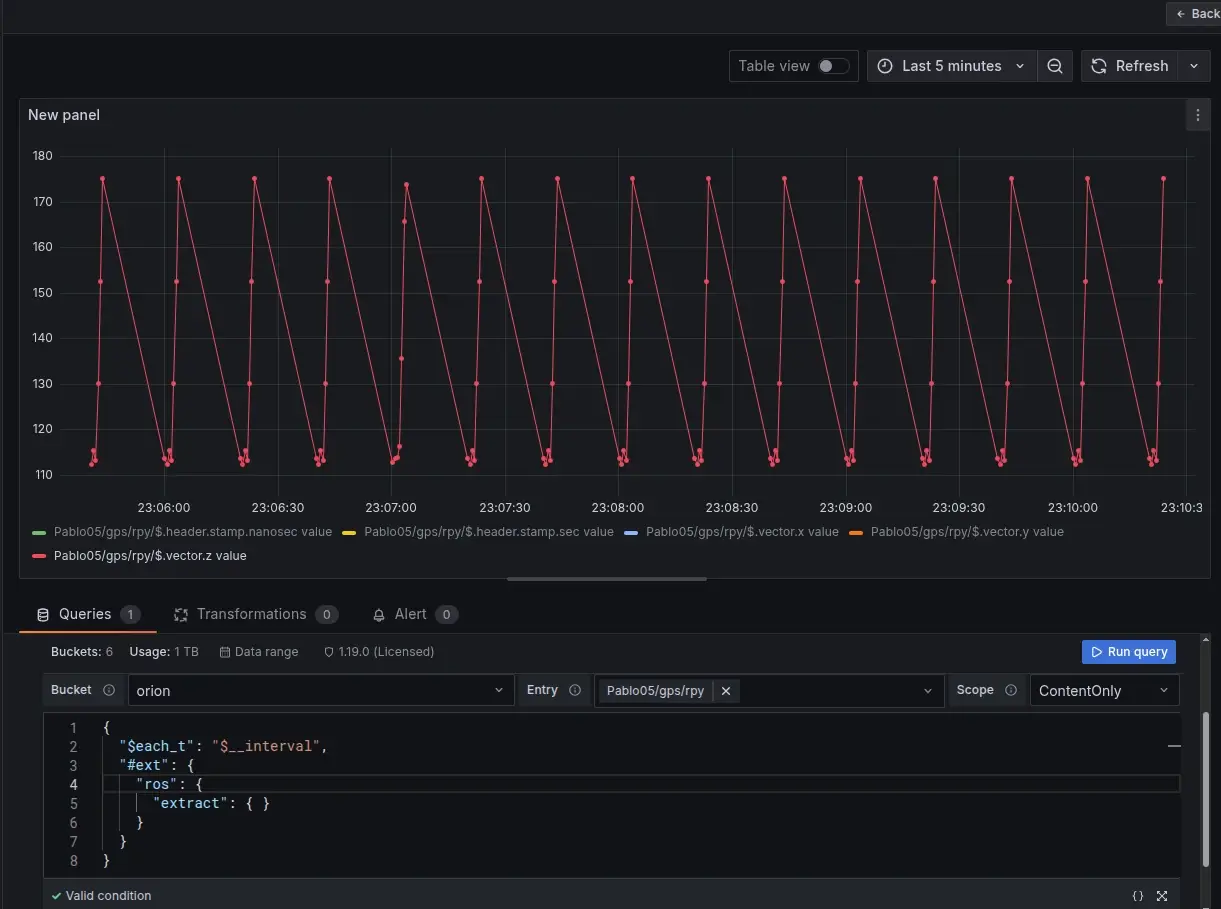
Grafana query editor with ReductROS extension

Grafana is a powerful tool for visualizing time-series data, and it is widely used for monitoring and analysis. However, it does not natively understand robotics data formats, such as ROS 2 messages, since they are usually stored in binary formats (e.g., CDR). ReductStore's flexible query engine and extension system can bridge this gap. With the ReductROS extension, you can extract ROS 2 messages as JSON directly in Grafana queries. This enables you to build rich dashboards and alerts on your robotics data without preprocessing it into a different format.
ReductStore v1.18.0 Released with Resilient Deployments and the Multi-entry API

· 5 min read
Alexey Timin
Co-founder & CTO - Database & Systems Engineering

ReductStore v1.18.0 Released

We are pleased to announce the release of the latest minor version of ReductStore, 1.18.0. ReductStore is a high-performance storage and streaming solution designed for storing and managing large volumes of historical data.

To download the latest released version, please visit our Download Page.

What's new in 1.18.0?​

In this release, we have added support for resilient deployments to build a more robust, fault-tolerant, and highly available ReductStore cluster. Now, you can implement hot-standby configurations, automatic failover, and seamless recovery to ensure uninterrupted service even in the face of hardware failures or network issues. You can also elastically scale read-only nodes to handle increased read workloads without impacting the performance of the primary nodes.

Additionally, we have introduced a new Multi-entry API that allows you to efficiently manage and query multiple entries in a single request. This API is designed to optimize performance and reduce latency when working with large datasets, making it easier to retrieve and manipulate data in bulk.