ReductStore v1.18.0 Released with Resilient Deployments and the Multi-entry API

We are pleased to announce the release of the latest minor version of ReductStore, 1.18.0. ReductStore is a high-performance storage and streaming solution designed for storing and managing large volumes of historical data.
To download the latest released version, please visit our Download Page.
What's new in 1.18.0?
In this release, we have added support for resilient deployments to build a more robust, fault-tolerant, and highly available ReductStore cluster. Now, you can implement hot-standby configurations, automatic failover, and seamless recovery to ensure uninterrupted service even in the face of hardware failures or network issues. You can also elastically scale read-only nodes to handle increased read workloads without impacting the performance of the primary nodes.
Additionally, we have introduced a new Multi-entry API that allows you to efficiently manage and query multiple entries in a single request. This API is designed to optimize performance and reduce latency when working with large datasets, making it easier to retrieve and manipulate data in bulk.
Resilient Deployments
In ReductStore v1.18.0, resilient deployments are now a first-class feature. Using the RS_INSTANCE_ROLE setting, you can build topologies that keep your ingestion endpoint available during node failures and scale reads independently from writes.
Hot standby (active-passive) for write availability
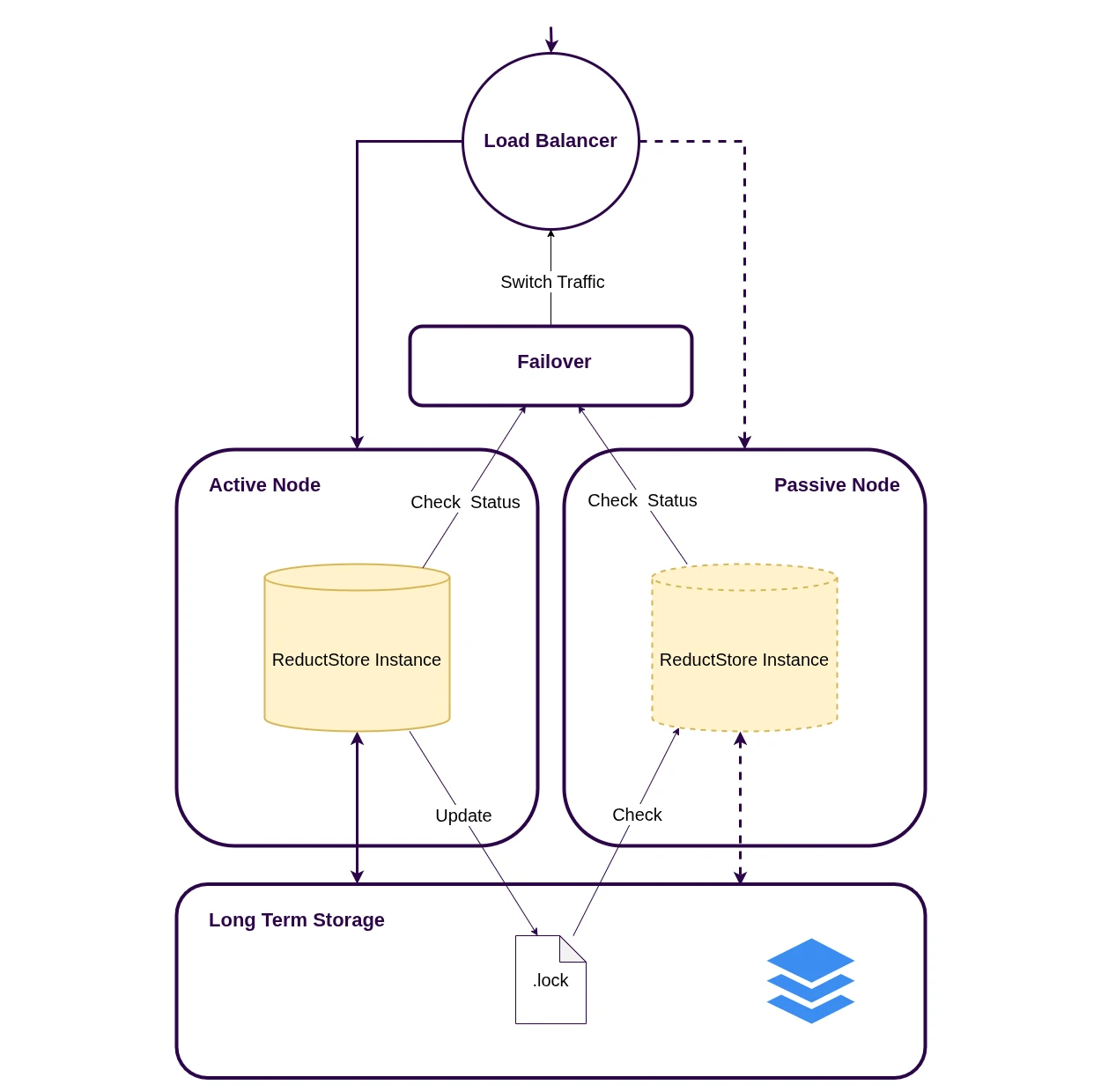
Run two nodes against the same backend (a shared filesystem or the same remote backend). Only one node is active at a time: the active node holds a lock file and refreshes it, while the standby waits and takes over when the lock becomes stale.
- Set
RS_INSTANCE_ROLE=PRIMARYfor the active node andRS_INSTANCE_ROLE=SECONDARYfor the standby. - Put both nodes behind a single virtual endpoint (load balancer / reverse proxy).
- Route traffic only to the node that returns
200 OKonGET /api/v1/ready(the inactive node returns503). - Tune failover behavior with
RS_LOCK_FILE_TTL(how long the standby waits) andRS_LOCK_FILE_TIMEOUT(how long a node waits to acquire the lock).
To avoid split-brain writes, don’t run both nodes in STANDALONE mode against the same dataset.
Read-only replicas for read scaling
Add one or more REPLICA nodes to serve queries from the same dataset. Replicas never write and periodically refresh bucket metadata and indexes from the backend, so newly written data may appear with a small delay.
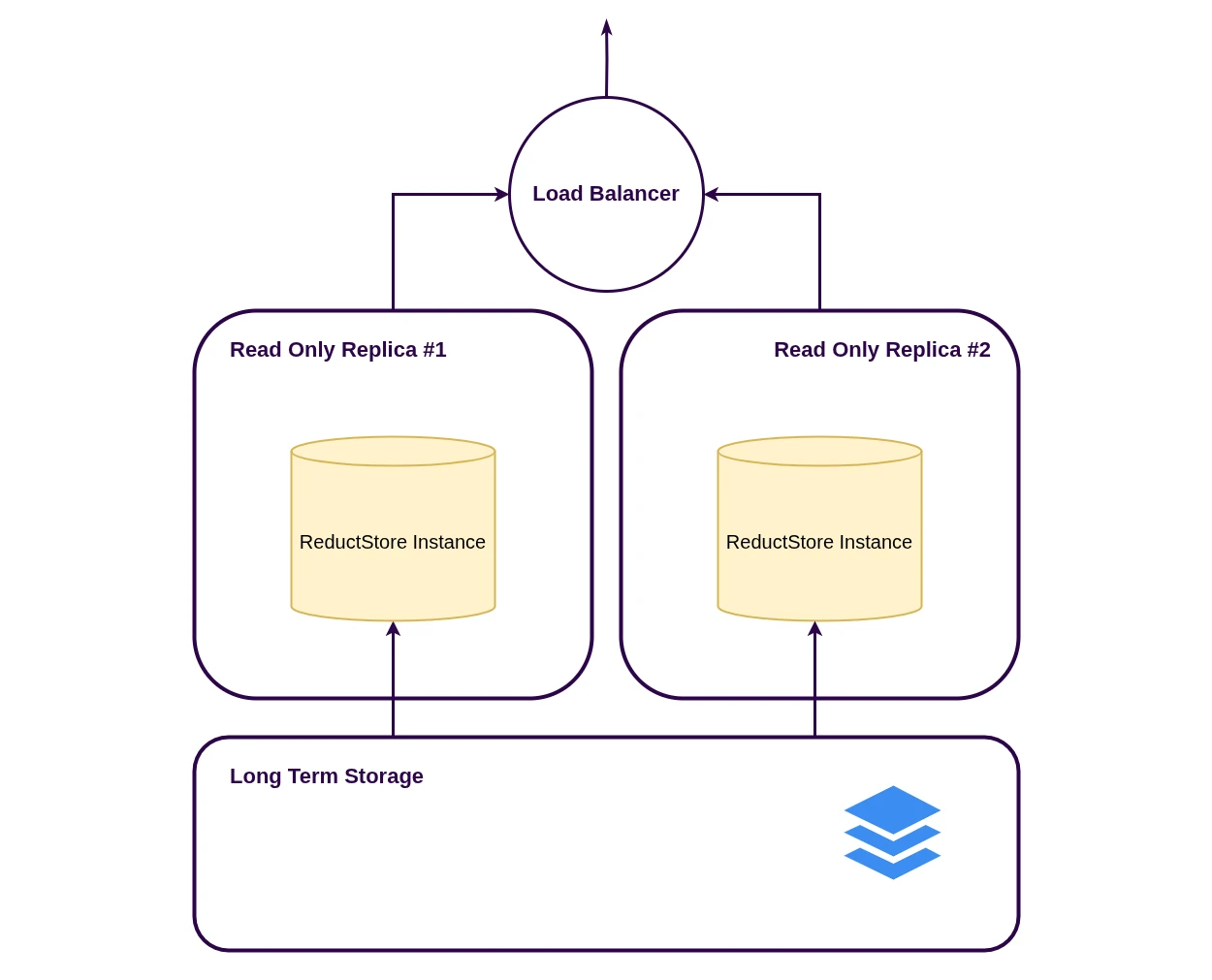
- Route writes to a dedicated ingestion node (or the active node in a hot-standby pair).
- Route reads to replicas to scale query workloads horizontally.
- Tune staleness with
RS_ENGINE_REPLICA_UPDATE_INTERVAL.
For an end-to-end walkthrough (including S3-based standalone, active-passive, and replicas), see the S3 Backend tutorial. For architecture options and operational notes, see the Disaster Recovery guide.
Multi-entry API
The new Multi-entry API makes it possible to work with multiple entries in a single request. In practice, this is most useful for querying: instead of running one query per sensor/stream and merging results on the client, you can request all the entries you need at once and process a single result stream (each returned record includes its entry name).
Here is a Python example using reduct-py to query multiple entries in one call:
import asyncio

from reduct import Client


async def main() -> None:
    async with Client("http://localhost:8383", api_token="my-token") as client:
        bucket = await client.get_bucket("my-bucket")

        # Query multiple entries in a single request (since ReductStore v1.18).
        # You can mix exact names and wildcards.
        entries = ["sensor-*", "camera"]
        async for record in bucket.query(
            entries,
            start="2026-02-05T10:00:00Z",
            stop="2026-02-05T10:05:00Z",
            when={"&score": {"$gte": 10}},
        ):
            payload = await record.read_all()
            print(record.entry, record.timestamp, len(payload))


if __name__ == "__main__":
    asyncio.run(main())
What’s Next
We’re already working on the next improvements to make ReductStore easier to integrate into real-world data pipelines:
Native Zenoh API
Zenoh is becoming a common choice for data exchange in distributed, edge-first systems (robotics, industrial IoT, and telemetry). In upcoming releases, we plan to add a native Zenoh API so ReductStore can join Zenoh networks seamlessly.
This will make it easier to ingest and serve data directly through Zenoh—without custom bridges—so your storage layer fits naturally into existing Zenoh-based deployments.
Entry attachments (metadata)
Today, labels work well for filtering and replication, but many projects also need structured metadata tied to an entry itself: data format, schema version, units, encoding, calibration details, and other context.
We plan to introduce attachments for entries, allowing you to store and retrieve this kind of metadata alongside your data streams, making datasets more self-describing and easier to consume across teams and tools.
I hope you find those new features useful. If you have any questions or feedback, don’t hesitate to use the ReductStore Community forum.
Thanks for using ReductStore!