6 posts tagged with "edge-computing"

View All Tags

Building Reliable Data Replication at the Edge

· 8 min read
Alexey Timin
Co-founder & CTO - Database & Systems Engineering

We originally built ReductStore to store data on edge devices and read it back by time interval. But a device only has so much disk space. With cameras and sensors writing all the time, we used a FIFO quota to remove the oldest records and make room for new ones. That left us with another problem: how to get the data off the device before it was deleted.

At first, transferring data from an edge device to central storage was a manual job. We used the CLI client or scripts and copied data when somebody remembered to do it. It was always problematic because data collection never stopped. Sometimes we had only two or three days to copy it before it was gone, and a temporary network problem or a missed run could make that window disappear completely.

Automatic replication was the next logical step. The edge is producing a stream of new data, while the central store has more capacity and can have different criteria for what it keeps. We needed to forward new records and configure source-side filters for each destination. Keeping two identical replicas was not the goal.

We also had to keep in mind that the source is usually on the edge. Very often it has no public IP address, and its network connection can be unstable, slow, or absent for long periods. Replication therefore could not make local ingestion wait for the central store. The device still needed to accept data first and deliver it later when a connection became available.

Reducing Annotation Work in High-FPS Vision Applications with Roboflow

· 5 min read
Anthony Cavin
Co-founder & CEO - Data, ML & Robotics Systems

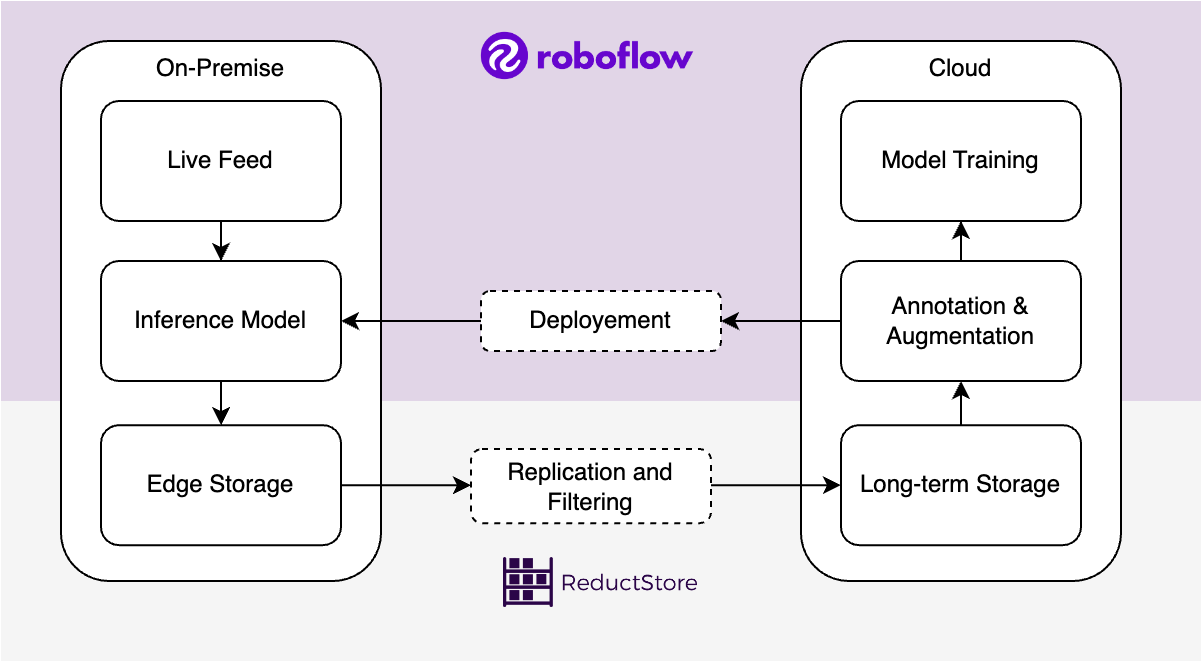
Roboflow Annotation Diagram

High-speed performance is a must for today's computer vision applications, but it comes with many challenges. These include processing a high volume of frames per second (FPS), which requires not only fast algorithms, but also efficient data storage to handle the large quantities of images being processed in real time.

Traditional annotation methods are often time-consuming and labor-intensive for training machine learning models. In other words, they create bottlenecks that slow down projects from getting done.

At the same time, Roboflow was designed to address the challenges associated with annotating data, but manually labeling all images is often tedious and unrealistic. In this case, ReductStore can provide the tools to query, filter, and replicate specific images for further annotation and training.

In this article, we'll explain how Roboflow can help reduce the time and effort required to annotate images, and how ReductStore can be used to store and filter important images.

YOLOv10 Training and Real-Time Data Storage

· 7 min read
Anthony Cavin
Co-founder & CEO - Data, ML & Robotics Systems

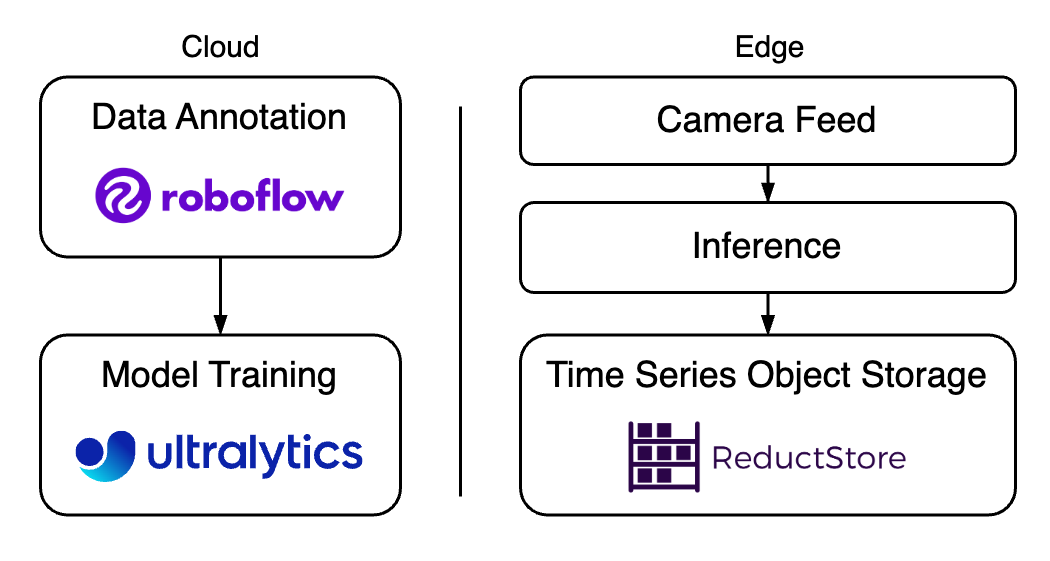
Block Diagram

Deploying a vision model like YOLOv10 at the edge has become a game-changer for real-time object detection. Developed by researchers at Tsinghua University, YOLOv10 introduces architectural innovations that optimizes speed and accuracy, making it ideal for vision tasks that require low inference latency.

This article provides resources for training a YOLOv10 model and managing data storage for real-time performance on edge devices. We will look at a combination of tools, including Roboflow for dataset preparation, Ultralytics for model training, and ReductStore for efficient data storage.