
13 posts tagged with "comparison"

View All Tags

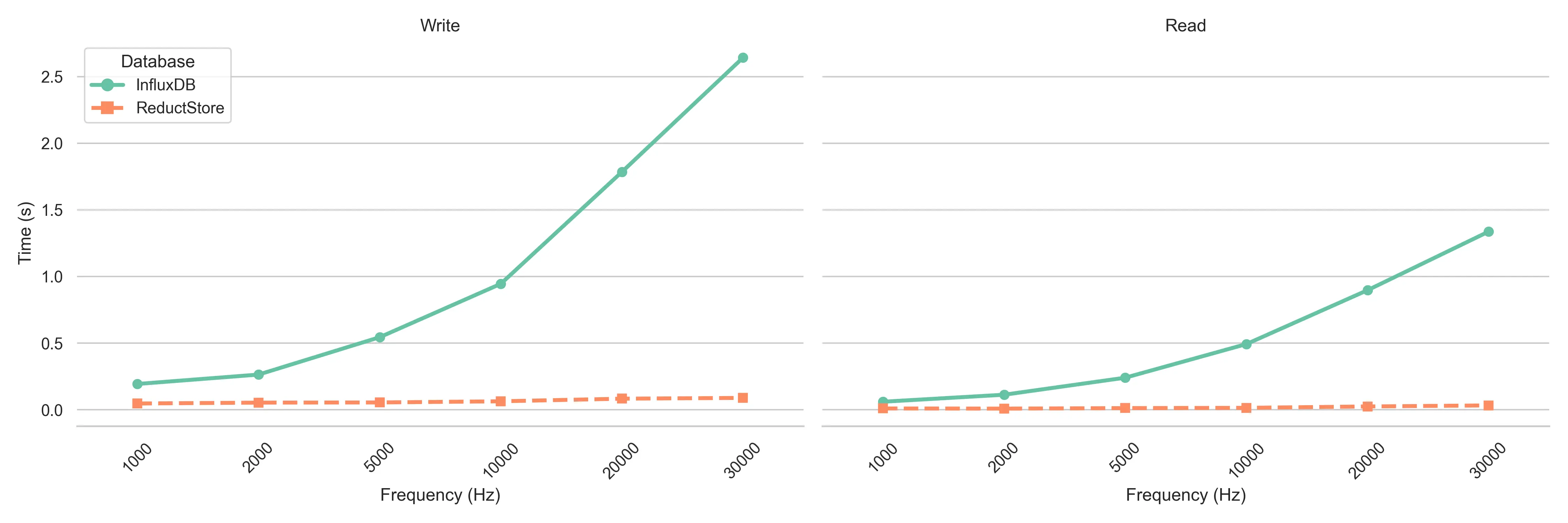
How to Store Vibration Sensor Data | ReductStore vs InfluxDB

· 10 min read
Anthony Cavin
Co-founder & CEO - Data, ML & Robotics Systems

Benchmark Results

In How to Store Vibration Sensor Data, we discuss the importance of efficiently storing both raw vibration data and pre-processed metrics, and the benefits of using time-series databases such as ReductStore. We explore best practices for setting up a time-series database and implementing data retention policies to effectively manage high-frequency sensor data.

We also see how to store vibration sensor values in 1-second chunks, each packaged as binary data, to optimize the storage process when dealing with high-frequency data such as vibration or acoustic measurements.

In this post, we compare ReductStore and InfluxDB in a real-world benchmark scenario, focusing on their write and read performance for high-frequency sensor data. We show how ReductStore's binary storage provides superior efficiency and scalability over InfluxDB when handling large volumes of unstructured time-series data.

The benchmark was run on an SSD drive, but results may vary depending on hardware configuration and database settings; to explore how it performs on your setup, you can run the benchmark yourself using the Reduct Vibration Example repository on GitHub.

Alternative to MongoDB for Blob Data

· 9 min read
Anthony Cavin
Co-founder & CEO - Data, ML & Robotics Systems

ReductStore vs MongoDB

In edge computing, managing time series blob data efficiently is critical for performance-sensitive applications. This blog post will compare ReductStore, a specialized time series database for unstructured data, and MongoDB, a widely-used NoSQL database.

Using Docker containers for straightforward setup, we'll examine the speed of each system. We'll go through setting up ReductStore buckets and preparing MongoDB collections, focusing on how to effectively store and access blob data for time series scenarios.

By conducting performance tests on binary data insertion and retrieval, we aim to provide insights into which system might best serve your application's needs.

For those interested in replicating our benchmarks or conducting their own evaluations, we've made our methods easily accessible through this repository.

Performance comparison: ReductStore Vs. Minio

· 7 min read
Alexey Timin
Co-founder & CTO - Database & Systems Engineering

In this article, we will compare two data storage solutions: ReductStore and Minio. Both offer on-premise blob storage, but they approach it differently. Minio provides traditional S3-like blob storage, while ReductStore is an alternative to store a history of blob data. We will focus on their application in scenarios that require storage and access to a history of unstructured data. This includes images from a computer vision camera, vibration sensor data, or binary packages common in industrial data.

Handling Historical Data

S3-like blob storage is commonly used to store data of different formats and sizes in the cloud or internal storage. It can also accommodate historical data as a series of blobs. A simple approach is to create a folder for each data source and save objects with timestamps in their names:

bucket
|
|---cv_camera
|---1666225094312397.jpeg
|---1666225094412397.jpeg
|---1666225094512397.jpeg